
Criminal Court Records in Caribou County
A criminal court record is the case-level record kept by the court after a prosecutor files a criminal accusation. It differs from a jail booking record or arrest report. The court file can include the complaint or information, probable-cause documents, charge amendments, plea forms, bond orders, no-contact orders, docket entries, hearing minutes, disposition, sentencing order, probation terms, fines, restitution, and public warrant activity. The narrower charge path is covered on the arrest records and court charges page, while custody questions belong with inmate records.
In Caribou County, misdemeanors and infractions are handled by magistrates. Felony first appearances and preliminary hearings begin before a magistrate; if a felony is held to answer, the case proceeds in district court before a district judge for trial, plea, sentencing, or other felony-level action. Caribou County is part of Idaho's Sixth Judicial District, and local court activity centers on the Magistrate & District Court in Soda Springs.
The Idaho Prosecuting Attorneys Association page for Caribou County Prosecutor S. Doug Wood identifies the local official responsible for prosecuting state criminal charges.
The prosecutor's role is central to criminal court records because the filed charge starts the court case, and later amendments, dismissals, pleas, and sentencing events are tracked by the court.
How to Search Caribou County Criminal Court Records
Start with the Idaho iCourt Portal for public criminal case information. Search by case number when possible. If no case number is available, use the defendant's name and narrow the results by court, case type, or date. Use the docket to identify hearings, charges, plea entries, disposition, sentencing events, and public warrant activity. For copies of pleadings, judgments, sentencing orders, or other case documents, use the courthouse kiosk or submit a request to the Caribou County clerk where the case was filed.
- Open Idaho iCourt and select case search or Smart Search.
- Search by defendant name or case number; use exact names and dates when available.
- Open the matching criminal case and review the charge list, docket entries, hearings, and disposition.
- Check whether any related warrant records or custody events appear, then verify with the court or sheriff if the matter is active.
- Request a certified copy from the Clerk of the District Court / County Clerk when the online summary is not enough.
The statewide public defense system is also relevant in criminal cases. The Idaho State Public Defender site explains the state-level structure for indigent defense.
Public-defender appointment happens through the court after a judge determines eligibility, so criminal defendants should ask the court about appointment in the case rather than treating the state website as a private lawyer directory.
Stages of a Criminal Case
Criminal dockets should be read as a sequence. A misdemeanor may move from complaint or citation to arraignment, pretrial hearings, plea or trial, disposition, and sentencing in the magistrate division. A felony usually begins with a first appearance and preliminary proceedings before a magistrate, then moves to district court if the case is held to answer. Each stage may create a docket entry and sometimes a separate document.
Case flow: Charges Filed › First Appearance / Arraignment › Preliminary Hearing for Felony › Pretrial / Motions › Plea or Trial › Disposition › Sentencing
| Stage | What Happens |
|---|---|
| Arraignment | The defendant is advised of the charge and enters a formal plea such as guilty or not guilty. |
| Preliminary Hearing | In felony matters, a magistrate determines whether the case should proceed to district court. |
| Pretrial / Motions | The parties file motions, address discovery, discuss plea terms, and prepare for trial or resolution. |
| Plea or Trial | The case resolves by plea, dismissal, acquittal, conviction, or trial verdict. |
| Sentencing | The court enters jail or prison terms, probation, fines, restitution, withheld judgment terms, or other lawful conditions. |
What a Caribou County Criminal Court Record Shows
Criminal case records can contain both summary fields and filed documents. The summary may show the case number, court, county, defendant name, prosecutor, defense attorney, judge, charge text, statute, severity, offense date, bond, hearings, plea, disposition, sentence, probation, fines, restitution, and warrant events. The full file may include the complaint, information, probable-cause affidavit if public, plea agreement, no-contact order, sentencing order, payment plan, and related motions or orders.
| Field | What It Shows |
|---|---|
| Case Number | The identifier used for exact iCourt lookup and clerk copy requests. |
| Defendant | The person accused by the State of Idaho in the criminal case. |
| Charges | The offense name, statute, level, filing date, and any amended or dismissed charge history. |
| Plea | The defendant's formal answer, such as guilty, not guilty, or another plea shown by the docket. |
| Disposition | The outcome of each charge, including dismissal, conviction, acquittal, withheld judgment, or other case resolution. |
| Sentence | Jail, prison, probation, fines, restitution, court costs, no-contact orders, and other conditions when entered. |
Charges vs. Convictions
A charge is an accusation filed in court. A conviction is a court outcome after a guilty plea, verdict, or other qualifying adjudication. A Caribou County criminal court record may show charges that were amended, reduced, dismissed, or resolved through a withheld judgment. That is why the final disposition matters more than the existence of a charge alone.
| Charge | Conviction | |
|---|---|---|
| Stage | Accusation filed by the State of Idaho | Final outcome after plea, verdict, or adjudication |
| Burden of Proof | Begins from probable cause and formal filing | Requires proof beyond a reasonable doubt or a qualifying plea |
| Public Record | Often public unless sealed or restricted | Often public unless sealed, shielded, juvenile, or otherwise restricted |
Reading Dispositions and Sentences
Disposition terms can include guilty, not guilty, dismissed, dismissed with prejudice, dismissed without prejudice, amended, acquitted, withheld judgment, probation, restitution, and sentence imposed. Idaho Code § 19-2604 relief and Clean Slate shielding can affect how a later record appears, but those concepts should not be described as automatic destruction of every record. If a record is being used for a legal decision, obtain the docket and the sentencing or disposition order from the clerk rather than relying only on a search result.
Sealed vs. Expunged Records
Idaho uses sealing, shielding, and dismissal relief in specific ways. Clean Slate shielding hides eligible records from public disclosure after the statutory process and waiting period, but it does not destroy the record. Idaho's use of expungement is narrower than casual public usage. Juvenile, sealed, victim-sensitive, and protected minor records may be withheld from ordinary public access even when other docket events are visible.
| Sealed or Shielded | Expunged | |
|---|---|---|
| Visibility | Hidden from ordinary public disclosure by rule or court order | Destroyed or removed only when Idaho law specifically allows it |
| Law Enforcement | May retain limited access depending on the order and record type | Access depends on the specific statute or court order |
| Eligibility | Clean Slate and sealing rules require specific conditions and court process | Not a general remedy for every adult criminal case in Idaho |
Public Access to Criminal Court Records
Public access is governed by Idaho Court Administrative Rule 32, which controls judicial-department records, and by Idaho public-records statutes for non-judicial public records. Idaho Code § 74-102 states the general public-records presumption. Idaho Code § 74-103 gives the three-working-day response framework, with notice within ten working days when more time is needed.
District defender contact structures are listed by the State Public Defender public defender offices page.
The defense side may appear in a criminal court record as appointed counsel, private counsel, district defender involvement, or self-represented status.
Key Statutes:
Idaho Court Administrative Rule 32 - governs access to Idaho judicial records and limits access for sealed or exempt materials.
Idaho Code § 19-2604 - addresses withheld-judgment and dismissal relief that may affect criminal case outcomes.
Background Check Considerations
Casual public lookup is not the same as an FCRA-compliant employment, tenant, credit, or insurance background check. A criminal court record can be incomplete online, updated after a delay, restricted by court order, or misread if charges are confused with convictions. The Idaho Judicial Branch provides a public party-verification channel, but official legal reliance should use the court file, certified records where needed, and the originating office.
The State Public Defender contact page at spd.idaho.gov/contact provides statewide public-defense contact information.
For appointment in a Caribou County criminal case, the practical route remains the judge and local court file, not a consumer background-check vendor.
Important: Do not use informal court-record lookup as a substitute for a legally compliant background-check process.
Restricted Criminal Court Records in Caribou County
Restricted criminal records can include sealed warrants, juvenile cases, victim-protection information, medical or mental-health material, protected addresses, minor-child information, sealed probable-cause materials, and records shielded through Clean Slate. Idaho treatment courts can also create specialized supervision records. The Idaho Judicial Branch treatment courts page at isc.idaho.gov/about-the-courts/treatment-courts explains the statewide model.
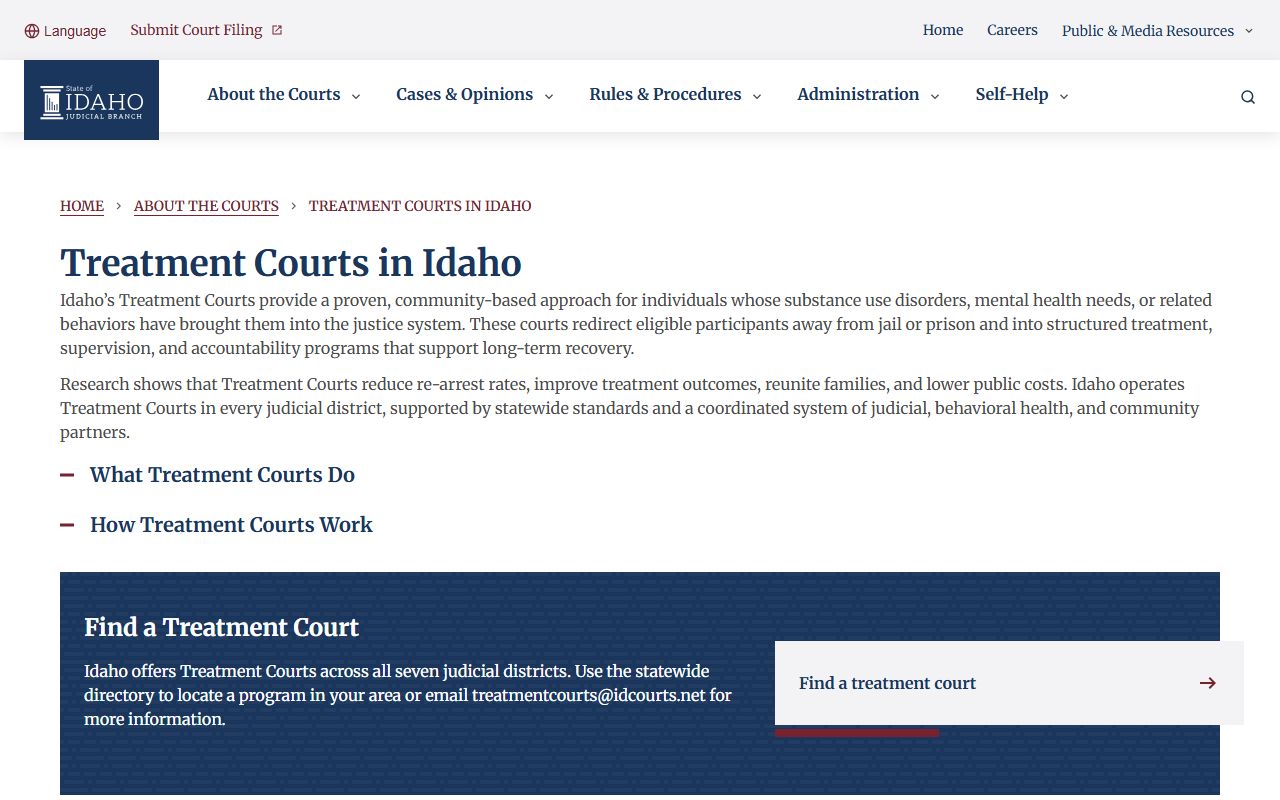
Caribou Felony Drug Court is identified in Judicial District 6 materials, but it is not a general public search portal; it is a supervised court track for eligible participants.